
April 21, 2026

Free Shipping On Orders Above $75


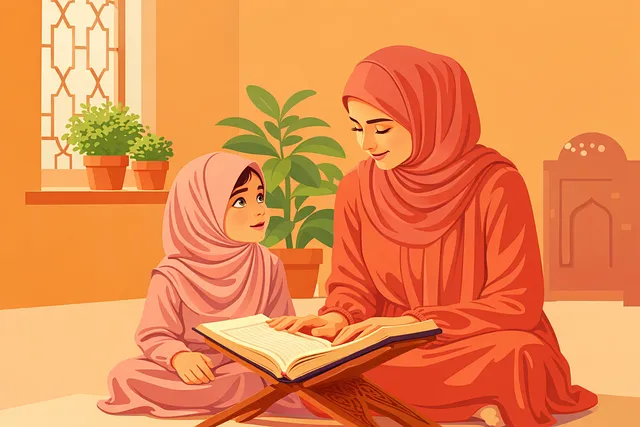


Your daughter is working on a school project when her little brother asks her to play with him. Frustrated, she snaps, “Stop bothering me, I’m busy!” You’re about to step in to calm her down when you remember that you used those exact words just the other day, when you were overwhelmed with chores and she came to you for help. These moments cause us to reflect on the importance of tarbiyah.
Tarbiyah isn't some lofty spiritual concept you implement on weekends or special occasions. It's the actual, daily work of raising children who know who Allah is. Islamic parenting is about building a generation rooted not just in rules, but genuine faith and character.
Tarbiyah is a huge responsibility in Islam. But when our efforts are grounded in the Qur’an and Sunnah, every minute spent raising our kids becomes an act of ‘ibadah.
When Islam talks about children being an amanah (a trust from Allah), it means we cannot outsource our job of Islamic parenting. We can't think, "Well, I send them to Islamic school" and consider our responsibility checked off. Allah reminds us of the magnitude of this responsibility in the following verse:
“O believers! Protect yourselves and your families from a Fire whose fuel is people and stones” (Surat at-Tahrim: 6).
But this doesn't mean that tarbiyah is about being harsh or controlling. Some of us grew up with parenting that was all discipline and no warmth, and we swore that we would be different with our own children. And maybe we have sometimes taken things too far in the opposite direction and then realized that never saying "no" doesn't actually help our kids thrive. Islamic parenting is that tricky, beautiful middle ground where we are both gentle and firm, both merciful and clear about boundaries.
The Prophet (PBUH) showed us this balance. He emphasized that gentleness and mercy are not optional in Islamic parenting; they are essential.
Tarbiyah is such an important part of Islam that Allah made Islamic parenting a part of the Qur’an and Sunnah. Here are some steps you can take to fulfill your duty of parenting in Islam more efficiently:
Here's the thing: kids notice everything. The big speeches you plan for tarbiyah aren’t as effective as the small, throwaway moments. Like when they see us holding in our anger after being cut off in traffic. Or they catch us admitting we were wrong about something.
These things might seem small to us, but these actions impact what our children learn and internalize daily. Consistent role modelling is crucial for parenting in Islam. If we expect honesty, kindness, and sincerity from them, they need to see it in us first, even in the smallest moments. Here is an example from the Seerah that shows this very idea:
Abdullah bin Amr narrated that his mother called him one day when the Messenger of Allah (PBUH) was sitting in their house. She said, “Come here and I shall give you something.” The Messenger of Allah (PBUH) asked her, “What did you intend to give him?” She replied, “I intended to give him some dates.” The Messenger of Allah (PBUH) said, “If you were not to give him anything, a lie would be recorded against you” (Sunan Abi Dawud 4991).
Children quickly learn to recognize whether or not their parents mean what they say. If we consistently practice what we preach, they will learn that integrity isn't situational. That's worth more for Islamic parenting than any lecture about honesty. So the question becomes: What are we actually teaching through how we live? Are we the people we want them to become?
We know from our Prophet’s example that kindness is an essential ingredient in tarbiyah.
Some of the Bedouins were surprised when they saw the Prophet (PBUH) kissing his children, and they commented that they never even kissed theirs. He told them, "I cannot help you if Allah has snatched kindness from your hearts" (Riyad as-Salihin 226).
Islamic parenting isn't about rigid perfection every single time. It's about affection being the foundation. Our kids need to know they're loved genuinely and unconditionally, even when they mess up... especially when they mess up.
Parenting in Islam looks like:
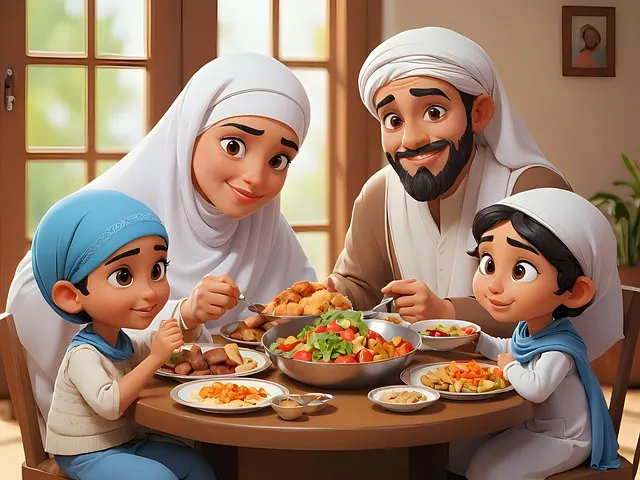
This is where tarbiyah gets beautiful instead of robotic. When you're young, Allah is the Friend who helps you find your lost toy or blesses you with your favourite ice cream after dinner. Kids understand Allah’s provision way before they understand the rules of Islamic practice.
So start your Islamic parenting there. When they come home hungry, "Alhamdulillah, Allah gave us food." When they're scared at night, "Allah is listening to us right now." When they do something kind without being asked, "That's what pleases Allah: being someone others can trust."
Read them stories. Not preachy ones, but engaging, age-appropriate narratives where characters struggle and grow and call out to Allah. Islamic books for children are a perfect tool for tarbiyah. They help kids understand their faith in a way that feels natural and meaningful.
Even Aisha (RA) learned from an early age through stories and play. The Prophet (PBUH) once saw a horse with two wings among her toys. When he asked her why the horse had wings, she replied,: “Have you not heard that Sulaiman had horses with wings?” (Sunan Abi Dawud: 4932).
The Prophet (PBUH) said to teach children to pray at age seven and discipline them if they're not praying by age ten (Jami` at-Tirmidhi 407). But this doesn’t mean being harsh in terms of tarbiyah. It means putting consequences in place that wake them up to what matters. There's a difference between hitting in anger and correcting with clarity.
In Islamic parenting, real discipline looks like:
When we skip small corrections, they grow into bigger problems. The little dishonesty becomes a pattern. The disrespect becomes entitlement. That's not Islamic parenting; it’s absence and neglect.
Tarbiyah isn't about raising perfect children. It's about raising kids who turn back to Allah, who grow through their mistakes, and who carry strong values into the world. An essential consequence of Islamic parenting is that our children see us as real people, not just authority figures. People that are trying, failing, repenting, and growing with them.
Let’s try our best and leave the results to Allah. As our children grow, they will ultimately have to choose their own path. So let’s not put too much pressure on ourselves. Because when it comes to tarbiyah, our responsibility is to show them the way with consistency, love, and genuine faith. May Allah bless our efforts and allow us to raise a generation that remembers Him, lives by His guidance, and brings good into the world. Ameen.
A: Tarbiyah in Islam refers to the upbringing of children based on Islamic values. It covers all aspects of bringing up a child including their emotional, spiritual, and physical development. In Islam, tarbiyah is not just the imposition of rules. Instead, it is a process of nurturing faith and strong character in children through love, support, kindness, discipline, and role-modeling.
A: As a Muslim parent, tarbiyah is a responsibility for which you are accountable before Allah. And fulfilling this duty starts with realizing that your children learn more from what you do rather than what you say. The values we wish for our children to adopt, we need to first practice them ourselves. Other practical ways to approach tarbiyah include creating an environment where children are exposed to the Qur’an and dhikr instead of music and TV shows, mentioning and thanking Allah in family moments, and making du’a for your children’s success in both worlds.
A: The Qur’an emphasizes the spiritual aspect of tarbiyah as much as the emotional and physical. In Islam, children are an amanah (trust) from Allah and we are encouraged to fear Him in our treatment of them. Allah says: "O you who have believed, protect yourselves and your families from a Fire whose fuel is people and stones" (Surah At-Tahrim 66:6). This verse shows that protecting our children from harm includes nurturing their faith and character, not only their physical safety.
A: Islamic books can play a significant role in tarbiyah for children. The ideas children are exposed to in their early years greatly impact their personality and the ideologies they develop. Today, the world of entertainment is dominated by Western ideologies. Replacing them with Islamic stories can prevent our children from feeling distant from their own religion and heritage. Islamic books are a powerful tool to inspire faith-based values in children from an early age.

.svg)
.webp)

$
12.99
12.99
12.99
£
10.49
12.99
12.99
12.99
12.99
12.99
Best Seller
October 6, 2026
Best Seller
Family
Values

$
13.99
13.99
13.99
£
11.49
13.99
13.99
13.99
13.99
13.99
Best Seller
October 6, 2026
Adventure
Values
$
13.99
13.99
13.99
£
11.49
13.99
13.99
13.99
13.99
13.99
Best Seller
October 6, 2026
Adventure
Values


.webp)
.webp)
.webp)
Be the first to know about our latest books, coupons, and giveaways!


.svg)


.webp)


Sign up today and get 10% off your first order!
Use this discount code at checkout: TENOFF