

July 28, 2026

Free Shipping On Orders Above $75





Children sometimes struggle through phases of restless nights—waking up in the middle of night because of nightmares, feeling anxious at bedtime, or simply struggling to sleep. And although a parent's hug can calm them down after a nightmare, the effect of the words that Allah has taught us through His Prophet (PBUH) goes much further. Both the duas before sleeping and the duas for waking up are meant to protect us from physical and hidden threats.
Reciting the duas with both faith and knowledge makes all the difference. When children know that angels are appointed as guards to protect them the whole night, they'll feel even stronger about learning the duas before sleeping. When they know the meaning of what they recite, they'll connect even better with Allah. And when they understand the huge favours Allah grants them even while they sleep, they'll be even more sincere in thanking Him through the duas for waking up.
Duas before sleeping and duas after waking up are short Sunnah supplications that Prophet Muhammad (PBUH) recited before sleep and immediately upon waking. They teach us to seek Allah's protection through the night and express gratitude for a new day—and are recommended as part of a Muslim's daily routine.
Islam describes sleep as a mini-death. Allah Almighty says in the Quran:
“It is Allah ˹Who˺ calls back the souls ˹of people˺ upon their death as well as ˹the souls˺ of the living during their sleep. Then He keeps those for whom He has ordained death, and releases the others until ˹their˺ appointed time. Surely in this are signs for people who reflect” (Surat az-Zumar: 42).
Every night when we close our eyes to sleep, we place our lives in the hands of our Creator. Our soul is taken in a way that only Allah knows, and it is returned to us only if He wills. Each morning we wake up is, in many ways, a new beginning, a fresh opportunity gifted to us by Allah. It is another chance to seek His pleasure, do good, and draw closer to Him. And what better way to begin that blessing than by starting the day with the beautiful duas for waking up in the morning?
So, let's explore these beautiful duas together and discover how this simple Sunnah can bring peace, comfort, and blessings into both your life and your children's.
The dua:

Transliteration: Bismika Allāhumma amūtu wa aḥyā.
Meaning: “With Your name, O Allah, I die and I live” (Sahih al-Bukhari 6324).
Whenever the Prophet (PBUH) intended to go to bed, he (PBUH) would recite this short dua. If you want your child to memorize a dua before sleeping in Arabic, this short and simple supplication is the best option to begin with.
Other than the basic dua before sleeping that we shared above, there are some Sunnah adhkar and duas the Prophet (PBUH) recited habitually every night to seek divine protection.
Mu‘awwidhat refers to the last three chapters of the Qur’an, i.e. Surat al-Ikhlas, Surat al-Falaq, and Surat an-Nas.

Meaning: “Say, ˹O Prophet,˺ ‘He is Allah—One ˹and Indivisible˺; Allah—the Sustainer ˹needed by all˺. He has never had offspring, nor was He born. And there is none comparable to Him’” (Surat al-Ikhlas 112:1-4).
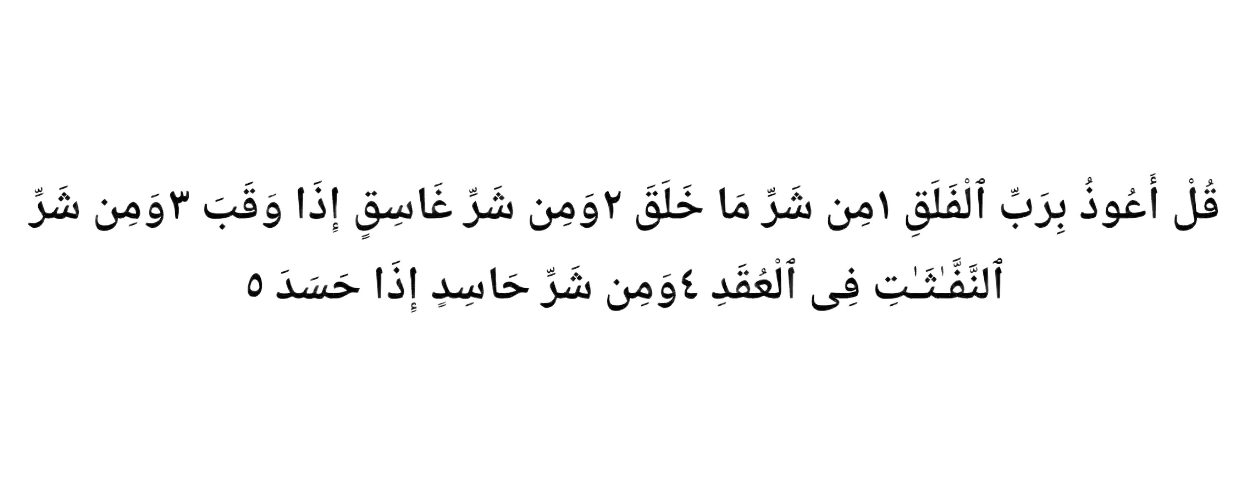
Meaning: “Say, ˹O Prophet,˺ ‘I seek refuge in the Lord of the daybreak from the evil of whatever He has created, and from the evil of the night when it grows dark, and from the evil of those ˹witches casting spells by˺ blowing onto knots, and from the evil of an envier when they envy’” (Surat al-Falaq 113:1-5).
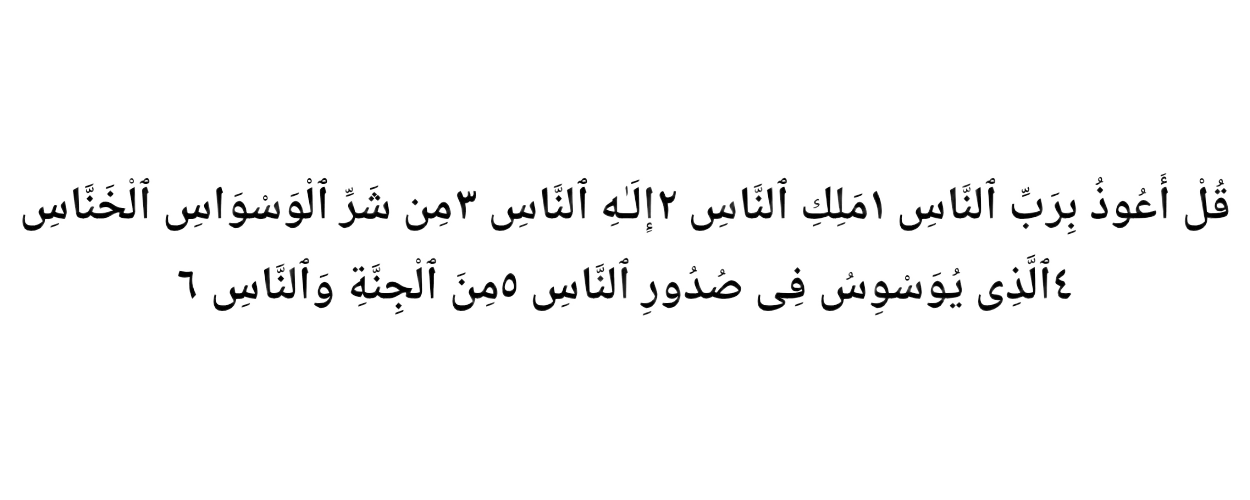
Meaning: “Say, ˹O Prophet,˺ ‘I seek refuge in the Lord of humankind, the Master of humankind, the God of humankind, from the evil of the lurking whisperer—who whispers into the hearts of humankind—from among jinn and humankind’” (Surat an-Nas 114:1-6).
One of the most recommended Sunnah practices before bed is to cup your hands together and recite the Mu‘awwidhat. Then, blow over your cupped hands and rub them over all parts of the body that you are able to rub, starting with the head, face, and the front of the body. This is something the Prophet (PBUH) used to do three times at night (Sahih al Bukhari 5017).
The dua:
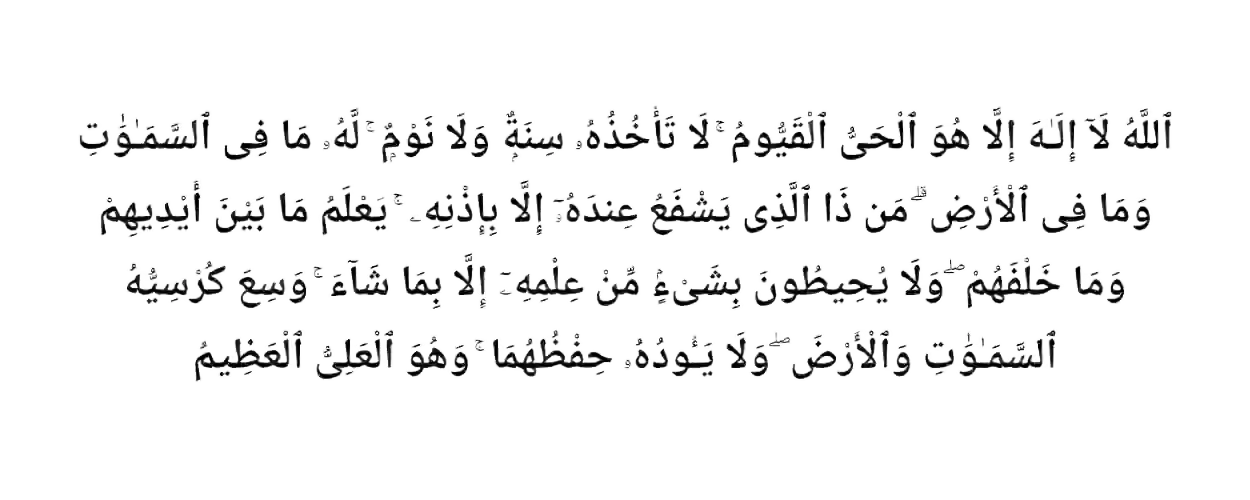
Meaning: “Allah! There is no god ˹worthy of worship˺ except Him, the Ever-Living, All-Sustaining. Neither drowsiness nor sleep overtakes Him. To Him belongs whatever is in the heavens and whatever is on the earth. Who could possibly intercede with Him without His permission? He ˹fully˺ knows what is ahead of them and what is behind them, but no one can grasp any of His knowledge—except what He wills ˹to reveal˺. His Seat encompasses the heavens and the earth, and the preservation of both does not tire Him. For He is the Most High, the Greatest” (Surat al-Baqarah 2:255).
Reciting the 255th ayah of Surat al-Baqarah before you sleep protects you from harm until morning. The Prophet (PBUH) confirmed that whoever recites Ayat al-Kursi before bed will have a guard appointed from Allah to protect them all night long, and no devil will come near them until morning (Sahih al-Bukhari 5010).

The dua:
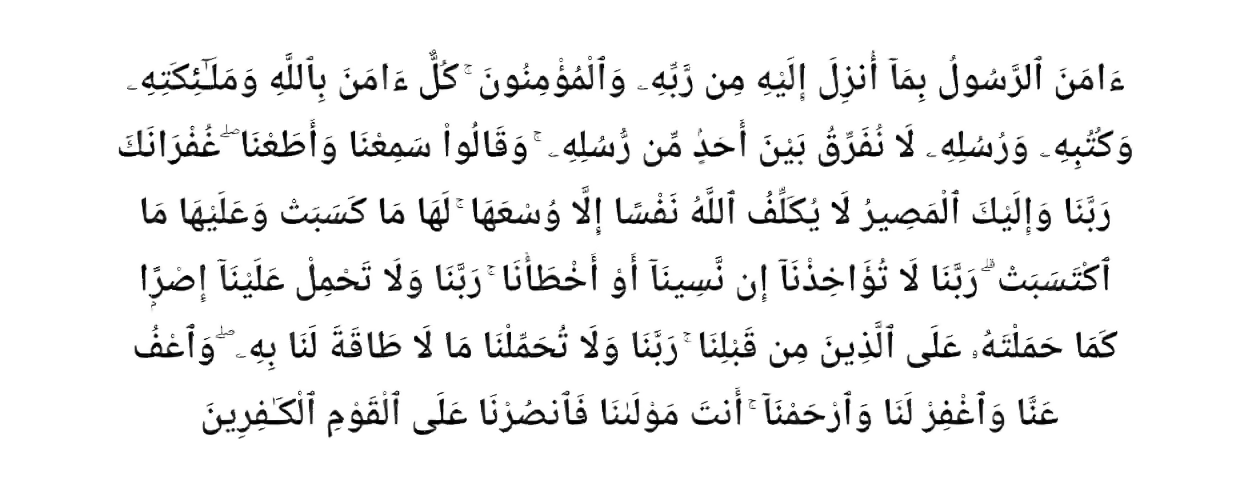
Meaning: “The Messenger ˹firmly˺ believes in what has been revealed to him from his Lord, and so do the believers. They ˹all˺ believe in Allah, His angels, His Books, and His messengers. ˹They proclaim,˺ “We make no distinction between any of His messengers.” And they say, “We hear and obey. ˹We seek˺ Your forgiveness, our Lord! And to You ˹alone˺ is the final return. Allah does not require of any soul more than what it can afford. All good will be for its own benefit, and all evil will be to its own loss. ˹The believers pray,˺ “Our Lord! Do not punish us if we forget or make a mistake. Our Lord! Do not place a burden on us like the one you placed on those before us. Our Lord! Do not burden us with what we cannot bear. Pardon us, forgive us, and have mercy on us. You are our ˹only˺ Guardian. So grant us victory over the disbelieving people” (Surat al-Baqarah 2:285-286).
According to the Hadith, reciting these verses at night is sufficient for protection (Sahih Muslim 808a).
Here is the Prophetic dua for waking up in the morning:
The dua:
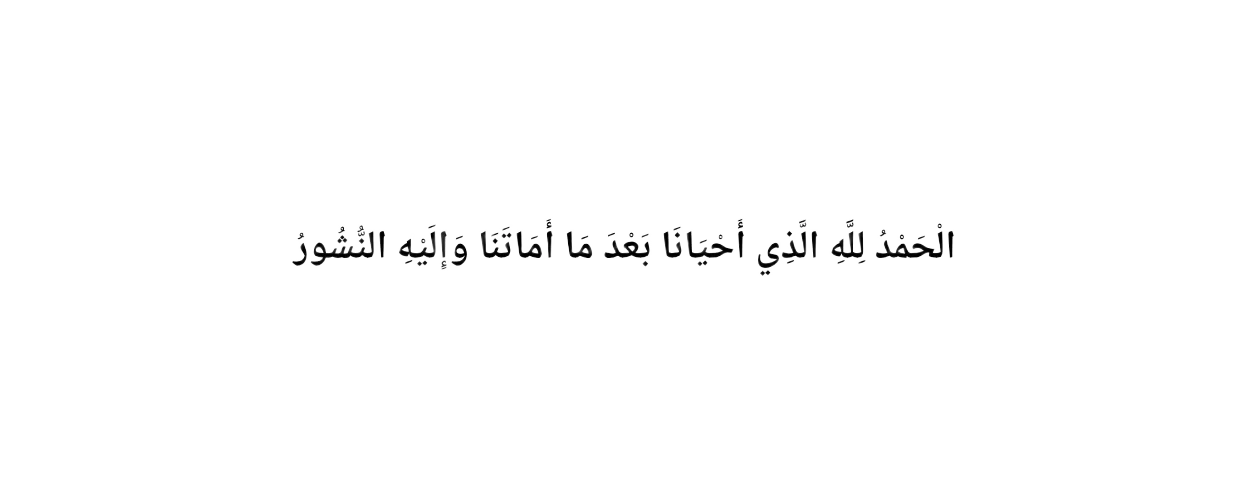
Transliteration: Alḥamdu lillāhil-ladhī aḥyānā ba'da mā amātanā wa ilayhin-nushūr.
Meaning: “All praise is for Allah who gave us life after having taken it from us and unto Him is the resurrection” (Hisn-al Muslim 1).
The dua:
.webp)
Transliteration: Alḥamdu lillāhil-ladhī 'āfānī fī jasadī, wa radda 'alayya rūḥī, wa adhina lī bi dhikrih.
Meaning: “Praise is to Allah Who gave strength to my body and returned my soul to me and permitted me to remember Him” (At-Tirmidhi 5/473).
The dua:

Transliteration: Lā ilāha illallāhu waḥdahu lā sharīka lah. Lahul-mulku wa lahul-ḥamd, wa Huwa 'alā kulli shay'in qadīr. Subḥānallāh, wal-ḥamdu lillāh, wa lā ilāha illallāh, wallāhu Akbar. Wa lā ḥawla wa lā quwwata illā billāhil-'Aliyyil-'Aẓīm. Rabbi-ghfir lī.
Meaning: “There is none worthy of worship but Allah alone, Who has no partner, His is the dominion and to Him belongs all praise, and He is able to do all things. Glory is to Allah. Praise is to Allah. There is none worthy of worship but Allah. Allah is the Most Great. There is no might and no power except by Allah's leave, the Exalted, the Mighty. My Lord, forgive me” (Hisn-al Muslim 2).
Modern neuroscience supports the habit of reciting duas for waking up in the morning. During the first hour after waking up, our brain is in a highly neuroplastic state—meaning we are more receptive to thoughts, emotions, and habits. Things we focus on during this time shape our mindset for the whole day. Starting the day with the dua for waking up calms both the heart and the nervous system and activates the body’s parasympathetic state, promoting peace and reducing stress.
Unfortunately, many of us are glued to screens during this crucial window, filling our mornings with headlines, social media, and endless comparisons. Instead of immersing ourselves in the distractions of the dunya, we should start the day with reflection and the dua for waking up. This mindful practice brings calm, clarity, and barakah in our life. And we must remember that barakah is not about having more time; it’s about the peace and productiveness Allah places in our time.
Teaching our children the duas for sleeping and waking up is crucial for protecting them from seen and unseen dangers. For children under the age of two, parents can recite the duas before sleeping at night and the duas for waking up in the morning on their behalf, making these beautiful supplications a part of their daily routine from an early age. As children begin to develop their speech, we can gently encourage them to memorize and recite the duas themselves.
Keep things simple by reciting the duas in your native language. To help children memorize the Arabic wording, begin with the short dua before sleeping. Help them understand why they are reciting these duas and how they bring us closer to Allah. Introduce the concepts of dhikr and dua through fun Islamic stories for kids. When children understand the purpose behind what they are learning, they are far more likely to remember it, cherish it, and carry it with them as they grow.
Even if we have successfully made it a habit to recite the duas for waking up in the morning and before sleeping, there are days when exhaustion wins, and we fall asleep without reciting them, or we’re so rushed in the morning that we forget them. But that is simply part of being human. The goal is not perfection. Rather, it is to keep showing up and keep trying, even if we do so imperfectly. So, if you miss a morning or a night, just begin again the next day with the same sincere intention.
If you're someone who struggles to build new habits, consider taking on a 21-day challenge to make the duas for waking up and the duas before sleeping at night a regular part of your routine. Set reminders on your phone for reciting these duas every night and every morning. Put the reminders on repeat for 21 days. Stay consistent, remain sincere, and trust Allah to make the habit second nature for you.
A: One of the shortest and most beautiful dua before sleeping is
(With Your name, O Allah, I die and I live). It's easy to memorize and a great starting point, though the Sunnah also encourages reciting Ayat al-Kursi and the three Quls before bed for added protection.
A: One of the Prophetic duas for waking up is:
Meaning: “All praise is for Allah who gave us life after having taken it from us and unto Him is the resurrection” (Hisn-al Muslim 1).
A: Before sleeping, the Prophet (PBUH) recited the three Quls (Surat al-Ikhlas, Surat al-Falaq, and Surat an-Nas), Ayat al-Kursi, and the prescribed dua before sleeping. After waking up, he recited the dua for waking up, praising Allah for giving him life after sleep. If the Prophet (PBUH) woke up during the night, he would also recite:
Meaning: “There is none worthy of worship but Allah alone, Who has no partner. His is the dominion, and to Him belongs all praise, and He is able to do all things. Glory is to Allah. Praise is to Allah. There is none worthy of worship but Allah. Allah is the Most Great. There is no might and no power except by Allah's leave, the Exalted, the Mighty. My Lord, forgive me” (Hisn al-Muslim, 2).
A: Sleep is described in the Quran as a kind of mini-death, where our soul is taken and only returned if Allah wills it. Reciting these duas is a way of entrusting ourselves to Allah each night and expressing gratitude each morning for the gift of another day.
A: For children under two, parents can recite the duas on their behalf, so it becomes a natural part of their routine early on. As their speech develops, you can gently encourage them to memorize and recite the duas themselves. Start with short duas and simple explanations that make memorizing Arabic easier.
A: It happens to all of us, and that's okay. The goal isn't perfection; it's sincerity and consistency. If you miss a night or morning, simply begin again next time with the same sincere intention, without guilt.

.svg)

.webp)

$
12.99
12.99
12.99
£
10.49
12.99
12.99
12.99
12.99
12.99
Best Seller
October 6, 2026
Best Seller
Family
Values

$
13.99
13.99
13.99
£
11.49
13.99
13.99
13.99
13.99
13.99
Best Seller
October 6, 2026
Adventure
Values
$
13.99
13.99
13.99
£
11.49
13.99
13.99
13.99
13.99
13.99
Best Seller
October 6, 2026
Adventure
Values


.webp)
.webp)
.webp)
Be the first to know about our latest books, coupons, and giveaways!


.svg)


.webp)


Sign up today and get 10% off your first order!
Use this discount code at checkout: TENOFF